
Ultrafiltration System - UF Plant
UF membrane systems for turbidity removal, suspended solids control, RO pretreatment, tertiary treatment and water reuse.
Request a quote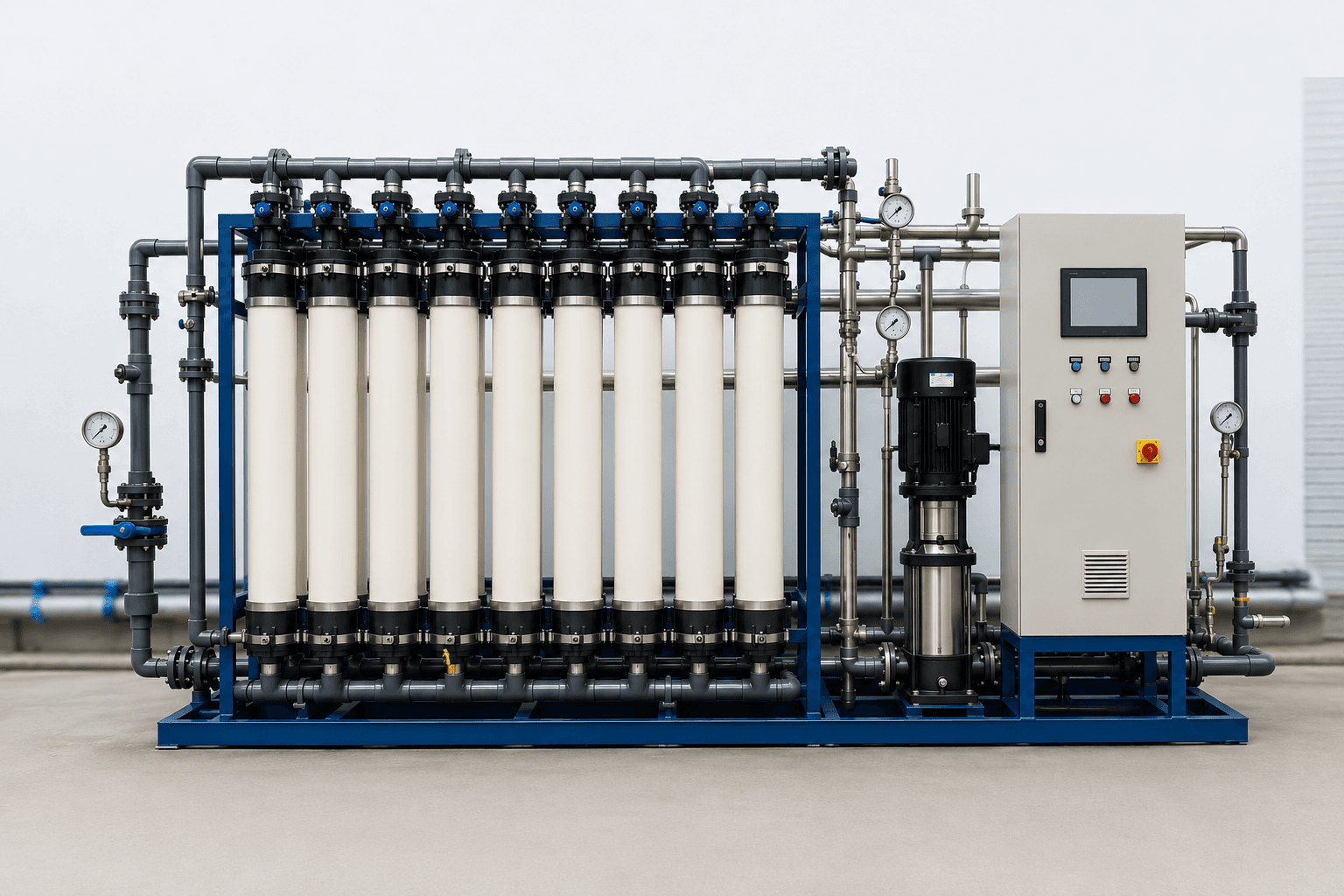
Overview
What is an Ultrafiltration System?
An Ultrafiltration System, commonly called a UF system or UF plant, is a low-pressure membrane filtration system used to remove turbidity, suspended solids, colloidal particles, algae, bacteria and high molecular weight organic matter from water. UF uses fine membrane pores to separate particles from water without removing dissolved salts. Terraquaer Venture Pvt. Ltd. designs and supplies UF systems for WTP, STP, ETP, RO pretreatment, MBR support, tertiary treatment, surface water treatment and treated wastewater reuse applications across Ahme

dabad, Gujarat and pan-India projects.
Why is UF Required?
UF is required when water has turbidity, fine suspended solids, colloidal particles, bacteria, algae or fluctuating clarity that cannot be managed reliably by conventional filtration alone. UF is also used to protect RO membranes by reducing SDI and particle fouling risk. In reuse projects, UF provides a consistent physical barrier after STP, ETP or tertiary treatment before the water is reused or sent to RO polishing.
When Should a UF System Be Used?
A UF system should be selected when the treatment objective is removal of turbidity, TSS, colloids and bacteria reduction, but not dissolved salt removal. UF is commonly used before RO, after biological treatment in STP or ETP systems, in surface water treatment plants, in tertiary reuse schemes and in industrial process water polishing. If low TDS water is required, UF is generally used as pretreatment before RO rather than as the final salt removal technology.
Where is UF Applied?
UF systems are applied in water treatment plants, sewage treatment plants, effluent treatment plants, tertiary treatment systems, RO pretreatment skids, MBR support systems, surface water treatment, river or lake water treatment, industrial reuse systems, commercial buildings, institutions, hospitals, hotels, municipal projects and manufacturing facilities. Industries using UF include pharmaceutical, food and beverage, dairy, textile, chemical, power, automobile, engineering and packaged water applications.
How Does a UF System Work?
UF works by passing water through hollow fiber membranes or other membrane modules under low pressure. Water passes through the membrane pores as filtrate or permeate, while suspended solids, turbidity, colloids and bacteria are retained. Flux is the water flow through a membrane area. TMP, or transmembrane pressure, is the pressure difference across the membrane and is monitored to understand fouling. Automatic backwash, air scouring, chemically enhanced backwash and CIP are used to remove accumulated solids and restore membrane performance.
Technical Overview and Design Factors
UF design depends on feed turbidity, TSS, SDI, particle size distribution, bacteria load, algae, color, organic load, oil and grease risk, iron, manganese, pH, temperature, flow variation, target recovery, target filtrate quality, membrane MOC, selected flux, backwash frequency, air scouring requirement, chemical cleaning compatibility, available space and downstream treatment requirement. Terraquaer does not assume final design values without reviewing water analysis, source variation and project objective.
UF Membrane MOC Types, Use and Application
UF membrane MOC, or material of construction, is selected based on feed water quality, chemical cleaning requirement, temperature, mechanical strength, fouling tendency and application. PAN membranes are often used for standard water clarification and RO pretreatment where cost-effective filtration is required. PVDF membranes provide good chemical resistance and are widely used in industrial water, wastewater reuse and tougher backwash conditions. Reinforced PVDF membranes add mechanical strength for higher durability and frequent backwash or air scour cycles. PES membranes are used where high permeability and good particle removal are needed, often in clean water and process water applications. PS/PES blend membranes may be selected for balanced performance and OEM-specific module designs. Ceramic UF membranes can be considered for high-temperature, high-chemical-resistance or difficult industrial streams, subject to feasibility and cost evaluation.
Major Components and Scope Elements
A complete UF system may include feed tank, feed pump, pre-strainer, membrane modules, hollow fiber membrane racks, filtrate tank, backwash pump, air blower for air scouring, chemical dosing systems, chemically enhanced backwash arrangement, CIP tank, CIP pump, valves, flow meters, pressure transmitters, TMP monitoring, turbidity meter, electrical panel, PLC or SCADA automation, skid structure, piping and instruments. UF may also be integrated with RO, UV, chlorination, storage and reuse distribution systems.
UF Applications in STP, ETP, WTP, RO and Reuse
In STP projects, UF can polish secondary or tertiary treated sewage for reuse or RO feed. In ETP projects, UF can reduce suspended solids and colloids before reuse or membrane recovery systems. In WTP projects, UF can treat surface water with variable turbidity and microbial load. As RO pretreatment, UF helps reduce SDI and protect RO membranes from particle fouling. In MBR support or retrofit applications, membrane-based filtration can improve treated water clarity when the process design and operating conditions support it. In water reuse projects, UF acts as a reliable filtration barrier before non-potable reuse or downstream polishing.
Operation, Backwash, CEB and CIP Requirements
UF operation requires monitoring of feed flow, filtrate flow, turbidity, TMP, pressure drop, recovery, backwash effectiveness, air scour sequence and chemical cleaning frequency. Backwash removes accumulated solids from membrane surfaces. Air scouring improves cleaning by agitating fibers. CEB, or chemically enhanced backwash, uses mild chemical cleaning during routine cycles. CIP, or clean-in-place, is deeper chemical cleaning used when TMP rises or flux declines beyond acceptable limits. Cleaning chemicals must match the membrane MOC and OEM recommendations.
Terraquaer’s Engineering and EPC / EPCC Scope
Terraquaer supports UF projects through water analysis review, pretreatment review, UF skid design, membrane MOC selection, flux and recovery planning, automation philosophy, equipment selection, procurement, fabrication coordination, supply, installation, commissioning, integration with RO or reuse systems, cleaning support, troubleshooting, revamping, operation and maintenance, and lifecycle support. Terraquaer’s approach focuses on membrane protection, maintainability, stable treated water quality and practical long-term operation.
Terraquaer Legacy and Capability Statement
Terraquaer Venture Pvt. Ltd. supports clients with practical, reliable and maintainable water and wastewater treatment solutions. Terraquaer’s strength lies in understanding actual site conditions, wastewater characteristics, client objectives, compliance requirements, lifecycle cost and long-term operation challenges before recommending a treatment system. As an EPC / EPCC environmental engineering company, Terraquaer helps clients from concept development to commissioning and long-term operation support.
Buyer Decision Guide
Before selecting a UF system, buyers should review water source, turbidity variation, TSS, SDI target, bacteria reduction requirement, organic load, oil and grease risk, RO feed requirement, reuse objective, membrane MOC, recovery target, automation need, cleaning chemicals, available space, reject or backwash disposal route, power cost and O&M capability. Terraquaer helps clients compare membrane options and select a UF configuration suitable for actual site conditions.
Final Call to Action
Contact Terraquaer Venture Pvt. Ltd. for UF system design, membrane selection, pretreatment review, skid engineering, automation, RO integration, commissioning, cleaning, troubleshooting, revamping or O&M support for WTP, STP, ETP, tertiary treatment, surface water treatment and reuse projects in Ahmedabad, Gujarat and across India.
Key features
- UF systems for turbidity removal, suspended solids removal, colloidal particle removal, bacteria reduction, RO pretreatment, tertiary treatment, surface water treatment and treated wastewater reuse
- Hollow fiber membrane options with pore size, flux, TMP, recovery, backwash, air scouring, chemically enhanced backwash and CIP considered during design
- Membrane MOC options can include PAN, PVDF, reinforced PVDF, PES, PS/PES blends and ceramic membranes depending on feed water and application
- Suitable for integration with STP, ETP, WTP, RO pretreatment, MBR support and industrial water reuse projects
- Available as skid-mounted, packaged, modular, containerized and MLD-scale engineered UF plants
- Automation options for filtration, backwash, air scour, CEB, CIP sequencing, pressure monitoring, turbidity monitoring and alarms
Key outcomes
- Improved water clarity through reduction of turbidity, suspended solids, colloids and bacteria load
- Better RO membrane protection by reducing SDI, particle fouling and biological loading before reverse osmosis
- Stable tertiary treated water quality for reuse, polishing or downstream RO treatment
- Lower operator dependency through automated backwash, air scouring, chemical cleaning and alarm logic
- Single EPC / EPCC support from pretreatment review and UF skid design to commissioning, cleaning and O&M
Standards & certifications
Final UF design depends on feed water quality, turbidity, TSS, SDI, organic load, oil and grease risk, bacteria load, target treated water quality, membrane MOC, recovery, backwash philosophy, cleaning chemistry, reuse objective, OEM membrane guidelines, statutory norms and client-specific project requirements.
Who it's for
Industries, EPC contractors, consultants, municipal utilities, hotels, hospitals, institutions, commercial buildings, residential societies and plant owners requiring low-pressure membrane filtration for WTP, STP, ETP, RO pretreatment, MBR support, surface water treatment or reuse projects.
Looking for something specific?
Tell us what you need to spec.
Share your capacity, compliance milestone, and timeline. An engineer responds within one business day.