
Pressure Sand Filters - PSF
Pressure sand filters for suspended solids, turbidity and fine particle removal in water and wastewater treatment systems.
Request a quote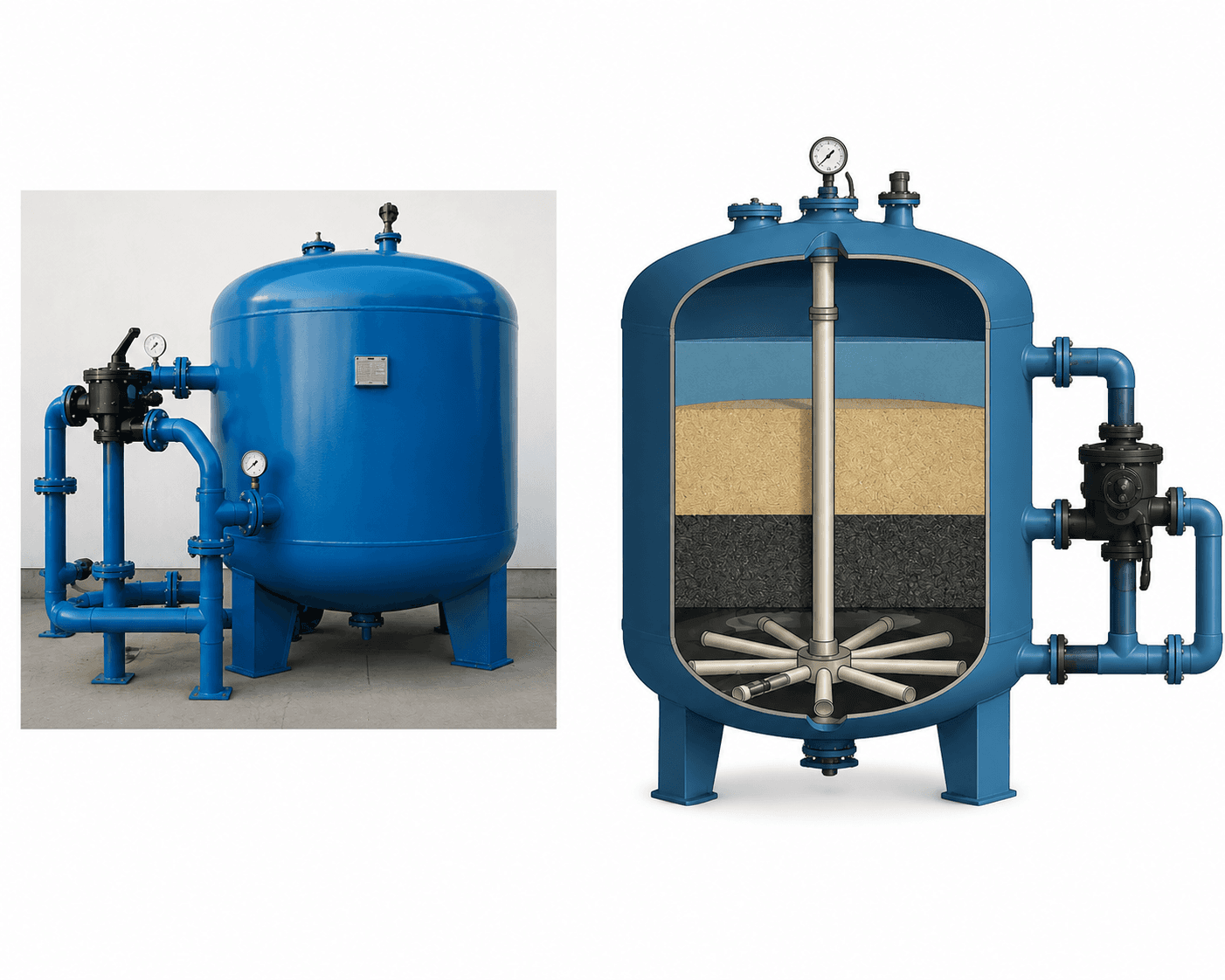
Overview
What is a Pressure Sand Filter?
A Pressure Sand Filter, commonly called a PSF, is a closed pressure vessel filtration system used to remove suspended solids, turbidity and fine particles from water. It contains graded sand media supported by gravel layers inside a pressure vessel. Water flows through the media bed, suspended particles are trapped, and filtered water is sent to downstream treatment or use. Terraquaer Venture Pvt. Ltd. supplies pressure sand filters for raw water, treated sewage, treated effluent, process water, utility water, tertiary treatment and RO pretreatment applications across Ahmedabad, Gujarat and pan-India projects.
Why is a Pressure Sand Filter Required?
A pressure sand filter is required when water contains suspended solids, turbidity, silt, fine particles or biological solids that can affect reuse quality, downstream equipment or process reliability. It is commonly used before activated carbon filters, softeners, RO plants, UV systems, cooling tower makeup systems and reuse distribution. In STP and ETP tertiary treatment, PSF helps polish treated water before discharge, reuse or further treatment.
When is a Pressure Sand Filter Used?
A PSF is used when suspended solids and turbidity must be reduced using a practical pressure filtration system. It is selected for raw water pretreatment, tertiary treated sewage filtration, tertiary treated effluent filtration, RO pretreatment, cooling tower makeup, drinking water polishing and industrial process water treatment. It is also used when treated water from biological or chemical treatment needs improved clarity before reuse or further polishing.
Where is a Pressure Sand Filter Installed?
Pressure sand filters are installed in water treatment plants, sewage treatment plants, effluent treatment plants, RO plants, cooling tower systems, boiler and utility water systems, municipal water projects, commercial buildings, hotels, hospitals, institutions, residential societies and industrial facilities. They are often placed after clarification or biological treatment and before activated carbon filters, softeners, RO membranes, UV disinfection or treated water storage.
How Does a Pressure Sand Filter Work?
During the service cycle, water enters the pressure vessel through the inlet valve and distributor. It flows through sand media and gravel support layers. Suspended solids and fine particles are retained in the media bed, while filtered water is collected through the bottom collection system or laterals. As solids accumulate, pressure drop across the vessel increases and outlet quality may decline. Backwash is then carried out by reversing flow through the media bed to expand and clean the filter media. After backwash and rinse, the filter returns to service.
Technical Overview and Design Factors
PSF design depends on flow rate, inlet turbidity, TSS, particle size, filtration velocity, vessel diameter, media depth, sand grade, gravel support, inlet distributor, collection internals, operating pressure, pressure drop, service cycle duration, backwash flow rate, backwash water availability, rinse requirement and downstream quality objective. Terraquaer does not assume final design values without reviewing actual water quality, application, site layout and operating requirements.
Types of Pressure Sand Filters
- Vertical down flow pressure sand filters are commonly used for compact flow ranges and standard packaged systems where space, handling and installation are simpler.
- Horizontal down flow pressure sand filters are used for larger flow rates or where a lower vessel height and larger filtration area are preferred. Terraquaer selects vertical or horizontal configuration based on flow rate, filtration velocity, available footprint, backwash requirement, site access and maintenance preference.
Pressure Vessel MOC Options
Pressure sand filter vessels can be supplied in different materials of construction based on application, pressure, corrosion risk, water chemistry and budget.
- FRP vessels : FRP vessels are lightweight and corrosion-resistant for many commercial and water treatment applications.
- MSEP or mild steel epoxy painted : MSEP or mild steel epoxy painted, is used for standard industrial duties where external and internal coating protection is suitable.
- MSFRP, or mild steel with FRP lining : MSFRP, or mild steel with FRP lining, improves corrosion resistance for more aggressive water compared with basic coated steel.
- MSRL, or mild steel rubber lined : MSRL, or mild steel rubber lined, is used where rubber lining compatibility and chemical resistance are needed.
- SS 304 and SS 316 : SS 304 and SS 316 vessels are selected for hygienic, corrosion-sensitive or process applications, with SS 316 preferred where chloride or corrosion risk is higher.
Final MOC selection depends on water quality, operating pressure, chemical exposure, installation environment and project specification.
Major Components and Scope Elements
- Pressure Vessel
- Top Distributor
- Bottom Collection System
- Strainers / Laterals
- Graded Sand Media
- Gravel Support Media
- Face Piping
- Inlet Valve
- Outlet Valve
- Backwash Inlet Valve
- Backwash Outlet Valve
- Rinse Valve
- Drain Valve
- Pressure Gauges
- Sampling Points
- Manual or Automatic Valve Arrangement
- Skid Frame
- Structural Supports
- Access Manhole
- Air Release Valve
- Instrumentation (where required)
Applications in STP, ETP, RO and Utility Water
In STP tertiary treatment, PSF reduces remaining suspended solids before reuse, disinfection or polishing. In ETP tertiary treatment, it helps remove carryover solids after clarification or biological treatment. In RO pretreatment, PSF reduces particulate load before cartridge filtration and membranes. In cooling tower makeup, it helps control suspended solids that can contribute to fouling. It is also used for drinking water polishing, process water treatment, industrial water treatment and utility water filtration.
Operation, Backwash and Maintenance Requirements
PSF operation requires monitoring of inlet pressure, outlet pressure, pressure drop, outlet turbidity, flow rate and service cycle duration. Backwash is required when pressure drop increases, service time is completed or outlet quality begins to decline. Correct backwash flow is important to expand and clean the media without media loss. Maintenance includes checking valves, internals, pressure gauges, media condition, channeling, mud ball formation, backwash effectiveness, vessel coating or lining and media replacement requirement.
Terraquaer’s Engineering and EPC / EPCC Scope
Terraquaer supports pressure sand filter projects through flow and water quality review, vessel sizing, filtration velocity selection, media selection, MOC selection, internals selection, piping layout, valve arrangement, skid engineering, procurement, fabrication coordination, supply, installation, commissioning, backwash setting, operator guidance, troubleshooting, media replacement planning and maintenance support. Terraquaer’s approach focuses on practical design, serviceability, correct backwash and long-term filtration performance.
Terraquaer Legacy and Capability Statement
Terraquaer Venture Pvt. Ltd. supports clients with practical, reliable and maintainable water and wastewater treatment solutions. Terraquaer’s strength lies in understanding actual site conditions, wastewater characteristics, client objectives, compliance requirements, lifecycle cost and long-term operation challenges before recommending a treatment system. As an EPC / EPCC environmental engineering company, Terraquaer helps clients from concept development to commissioning and long-term operation support.
Buyer Decision Guide
Before selecting a pressure sand filter, buyers should review flow rate, inlet turbidity, TSS, particle load, filtration velocity, expected service cycle, available pressure, backwash water source, drain arrangement, automation need, vessel MOC, available space, downstream treatment requirement and maintenance access. Terraquaer helps clients select practical PSF sizing and arrangement for actual operating conditions.
Final Call to Action
Contact Terraquaer Venture Pvt. Ltd. for pressure sand filter sizing, vessel MOC selection, filtration media selection, piping and valve arrangement, installation, commissioning, backwash setting, troubleshooting and maintenance support for STP, ETP, RO pretreatment, drinking water, cooling tower makeup and industrial water treatment projects in Ahmedabad, Gujarat and across India.
Key features
- Removes suspended solids, turbidity and fine particles from raw water, treated sewage, treated effluent, process water and utility water
- Uses graded sand media, gravel support, pressure vessel, internals, valves and backwash arrangement for pressure filtration
- Suitable for STP tertiary treatment, ETP tertiary treatment, RO pretreatment, cooling tower makeup, drinking water and industrial water treatment
- Available as vertical down flow and horizontal down flow pressure sand filter configurations
- MOC options can include FRP, MSEP, MSFRP, MSRL, SS 304, SS 316 and project-specific vessel materials
- Terraquaer supports vessel sizing, media selection, piping, valves, installation, commissioning, backwash setting and maintenance
Key outcomes
- Improved water clarity and reduced turbidity before reuse, discharge, RO, utility or process use
- Protection of downstream RO membranes, activated carbon filters, softeners, UV systems and utility equipment
- Reliable filtration service cycle when velocity, media depth, pressure drop and backwash are correctly selected
- Flexible vessel MOC and layout options for commercial, industrial, municipal and wastewater reuse projects
- Single EPC / EPCC support from design and supply to commissioning, troubleshooting and O&M
Standards & certifications
Final PSF sizing and MOC selection depend on flow rate, inlet turbidity, suspended solids, particle load, filtration velocity, pressure drop, service cycle, backwash water availability, operating pressure, water chemistry, site conditions, downstream equipment requirement and client-specific standards.
Who it's for
Industries, consultants, EPC contractors, STP and ETP owners, RO plant operators, hotels, hospitals, institutions, residential societies, municipal bodies and utility teams requiring reliable pressure filtration for raw water, treated sewage, treated effluent, process water or utility water.
Looking for something specific?
Tell us what you need to spec.
Share your capacity, compliance milestone, and timeline. An engineer responds within one business day.