
MBR Membrane Based Wastewater Treatment System
MBR wastewater systems combining biological treatment and membrane separation for compact, high-quality treated water reuse.
Request a quote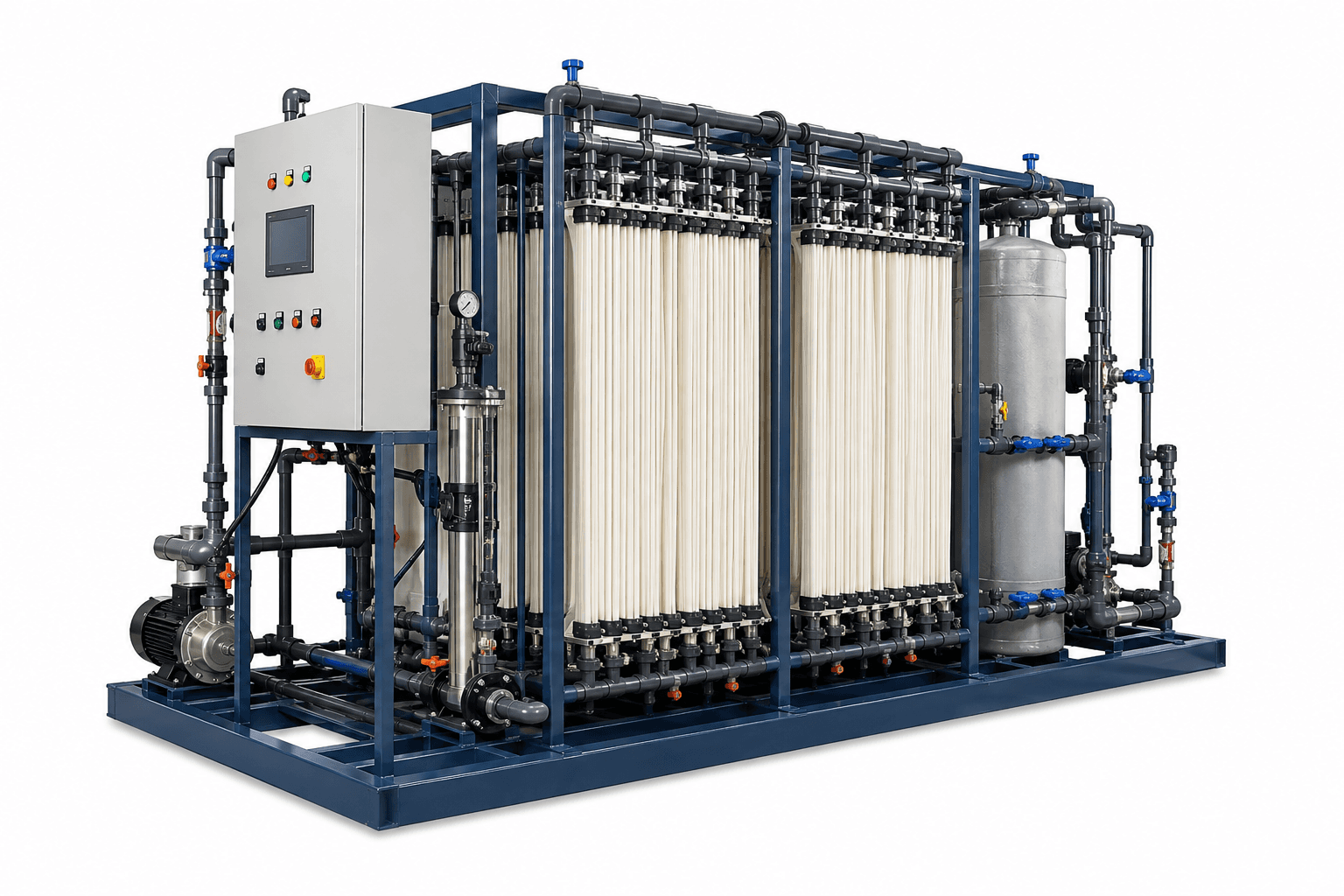
Overview
What is an MBR Membrane Based Wastewater System?
An MBR, or Membrane Bioreactor, is a wastewater treatment system that combines biological treatment with membrane separation. In a conventional biological plant, treated water is separated from biological sludge in a secondary clarifier. In an MBR system, membrane modules perform this solid-liquid separation, producing clearer treated water with very low suspended solids. Terraquaer Venture Pvt. Ltd. designs and supplies MBR membrane based wastewater systems for sewage treatment, industrial wastewater treatment, retrofit upgrades and reuse-oriented projects across Ahmedabad, Gujarat and pan-India locations.
Why is MBR Required?
MBR is required when a project needs compact footprint, improved treated water quality, reduced clarifier dependency, lower TSS in outlet water and better suitability for reuse. It is useful where site area is limited, conventional clarifiers are difficult to fit, treated water must be reused for flushing, gardening, cooling tower makeup or downstream RO, or an existing STP or ETP requires performance improvement through retrofitting.
When is MBR Selected?
MBR is selected when treated water quality, reuse goals, space constraints, high MLSS operation or retrofit requirements justify membrane-based separation. It is commonly selected for premium residential and commercial projects, hotels, hospitals, resorts, industrial townships, institutions, municipal decentralized systems and industrial wastewater projects where biological treatment is feasible and a higher quality treated water output is required.
Where is MBR Used?
MBR systems are used in sewage treatment plants, effluent treatment plants, commercial buildings, residential societies, hotels, hospitals, resorts, educational institutions, industrial parks, pharmaceutical units, food and beverage plants, dairy plants, textile units, chemical industries and municipal reuse projects. MBR can also support STP and ETP upgrades where existing clarifier performance, footprint or outlet TSS is a concern.
How Does an MBR System Work?
An MBR system treats wastewater biologically in an aeration tank or bioreactor where microorganisms reduce BOD, COD and biodegradable organic matter. The mixed liquor contains MLSS, or mixed liquor suspended solids, which represents the biological solids in the reactor. Instead of relying mainly on a secondary clarifier, wastewater passes through membrane modules installed in a membrane tank or integrated bioreactor. A permeate pump draws treated water through the membranes, while air scouring helps keep membrane surfaces clean. Backwash, relaxation and chemical cleaning are used to control fouling. TMP, or transmembrane pressure, and flux are monitored to understand membrane loading and cleaning need.
Technical Overview and Design Factors
MBR design depends on wastewater type, flow rate, peak flow, BOD, COD, TSS, pH, oil and grease, nutrients, temperature, toxicity, biological treatability, MLSS range, sludge age, hydraulic retention time, food-to-microorganism ratio, membrane flux, TMP limits, air scouring demand, membrane tank layout, sludge wasting, backwash frequency, chemical cleaning method, treated water reuse objective and statutory outlet norms. Final design values should be selected after reviewing actual wastewater characteristics and site conditions.
MBR Membrane MOC Types, Pros and Cons
MBR membrane material of construction is selected based on wastewater type, fouling risk, chemical cleaning requirement, mechanical strength, temperature, oil and grease exposure and lifecycle cost. PVDF membranes are widely used in municipal sewage and many industrial wastewater applications because they offer good chemical resistance, mechanical strength and fouling tolerance; their limitation is that performance still depends heavily on pretreatment, oil control and cleaning discipline. PTFE membranes provide strong chemical resistance and hydrophobic behavior that can suit difficult industrial streams and aggressive cleaning conditions; they can be more expensive and require careful module selection. PVC membranes can be cost-effective for selected sewage or lower-risk wastewater applications; their chemical and temperature resistance may be more limited than PVDF or PTFE depending on OEM design. PES membranes can offer good permeability and filtration performance for lower-fouling applications, but chemical compatibility and fouling behavior must be checked. Ceramic membranes can be considered for high-temperature or difficult industrial wastewater where strong chemical and mechanical resistance is needed, but capital cost is typically higher. Terraquaer selects membrane MOC after reviewing wastewater quality, cleaning chemistry and the practical O&M environment.
Major Components and Scope Elements
A complete MBR system may include screening, collection tank, equalization tank, anoxic or aerobic biological tank, aeration system, membrane tank, membrane modules, air blowers, diffusers, air scouring grid, permeate pump, backwash system, chemical cleaning tank, CIP dosing system, sludge wasting arrangement, treated water tank, instruments, valves, piping, electrical panel, PLC/SCADA automation and optional tertiary disinfection or RO integration for reuse.
Applications and Industries Served
MBR systems are used for sewage treatment, industrial wastewater treatment, STP upgrades, ETP polishing, decentralized municipal treatment, compact commercial STPs, hospital and hotel wastewater treatment, township reuse projects and industrial water reuse. Industries served include residential and commercial developments, healthcare, hospitality, education, municipal utilities, pharmaceutical, food and beverage, dairy, textile, chemical, automobile, engineering and industrial parks.
Operation, Cleaning and Maintenance Requirements
MBR operation requires routine monitoring of flow, MLSS, dissolved oxygen, pH, BOD, COD, TSS, sludge wasting, membrane flux, TMP, permeate flow, air scouring, blower performance, backwash sequence and chemical cleaning frequency. Membrane fouling can increase TMP and reduce permeate flow. Proper screening, oil and grease control, aeration balance, sludge management, backwash, relaxation and chemical cleaning help maintain membrane performance.
Terraquaer’s Engineering and EPC / EPCC Scope
Terraquaer supports MBR projects through wastewater review, process design, biological sizing, membrane MOC selection, membrane module selection, air system design, skid integration, equipment selection, procurement, fabrication coordination, supply, installation, commissioning, automation, operator training, membrane replacement, retrofitting, troubleshooting, operation support and lifecycle O&M. Terraquaer can help with new MBR plants, conversion of existing STP or ETP systems to MBR, membrane replacement planning, permeate system correction, air scouring optimization and cleaning support.
Terraquaer Legacy and Capability Statement
Terraquaer Venture Pvt. Ltd. supports clients with practical, reliable and maintainable water and wastewater treatment solutions. Terraquaer’s strength lies in understanding actual site conditions, wastewater characteristics, client objectives, compliance requirements, lifecycle cost and long-term operation challenges before recommending a treatment system. As an EPC / EPCC environmental engineering company, Terraquaer helps clients from concept development to commissioning and long-term operation support.
Buyer Decision Guide
Before selecting an MBR system, clients should review wastewater source, flow variation, BOD, COD, TSS, pH, oil and grease, biological treatability, reuse target, available footprint, membrane MOC, air demand, power cost, chemical cleaning requirement, sludge handling method, automation level, operator capability and lifecycle maintenance cost. Terraquaer helps clients compare conventional biological treatment, MBBR, SBR and MBR options based on actual site conditions.
Final Call to Action
Contact Terraquaer Venture Pvt. Ltd. for MBR membrane based wastewater system design, new MBR plant execution, MBR retrofitting, membrane replacement, skid integration, air system design, commissioning, operation support, troubleshooting and O&M for sewage or industrial wastewater treatment projects in Ahmedabad, Gujarat and across India.
Key features
- Combines biological treatment with membrane separation for sewage and industrial wastewater treatment
- Uses membrane modules, membrane tank, aeration, permeate pumping, air scouring, backwash and chemical cleaning provisions
- Designed around MLSS, membrane flux, TMP, hydraulic loading, organic loading, sludge age and treated water quality objective
- Compact footprint with reduced dependency on secondary clarifiers compared with conventional activated sludge systems
- Suitable for treated water reuse after STP, ETP, township, hotel, hospital, commercial and industrial wastewater treatment
- Supports new MBR plants, MBR retrofitting, membrane replacement, skid integration, air system design, commissioning and O&M
Key outcomes
- Improved treated water clarity with lower suspended solids and better reuse readiness
- Compact treatment layout for sites with limited area or high treated water expectations
- Reduced clarifier dependency through membrane-based solid-liquid separation
- Better control of biological solids using MLSS, aeration, membrane tank operation and sludge management
- Single EPC / EPCC support from process design and membrane selection to troubleshooting and lifecycle operation
Standards & certifications
Final MBR design depends on sewage or effluent characteristics, flow rate, BOD, COD, TSS, pH, oil and grease, nutrients, toxicity, biological treatability, MLSS range, membrane flux, TMP limits, reuse objective, discharge norms, site condition and client-specific operating requirements.
Who it's for
Residential societies, commercial complexes, hotels, hospitals, resorts, institutions, municipal bodies, industrial townships, factories, process industries, consultants and plant owners requiring compact wastewater treatment, high treated water quality and reuse-ready output.
Looking for something specific?
Tell us what you need to spec.
Share your capacity, compliance milestone, and timeline. An engineer responds within one business day.