
Filter Press
Industrial filter press for ETP/STP sludge dewatering, available in manual, automatic, recessed plate and membrane types.
Request a quote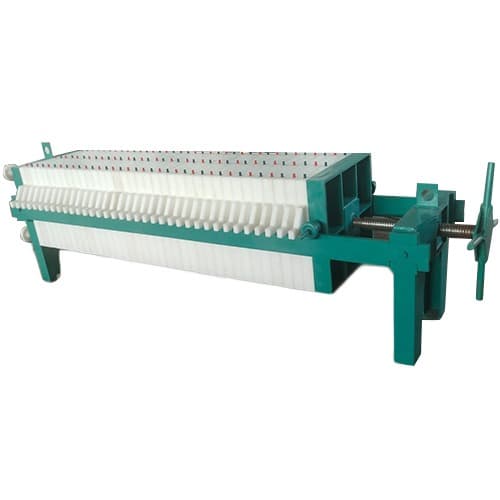
Overview
A Filter Press is a pressure-driven, batch-type sludge dewatering system used to separate solids from liquids in ETPs, STPs, WTPs and industrial process plants. Slurry is pumped into chambers formed between filter plates. Liquid passes through the filter cloth as filtrate, while solids are retained between the plates and discharged as dewatered cake at the end of the cycle.
Terraquaer supplies filter presses in manual, semi-automatic and automatic configurations, with recessed chamber, plate-and-frame and membrane plate options selected according to sludge volume, cake dryness requirement, chemical compatibility, available manpower and disposal method.
How Does a Filter Press Work?
1. Sludge Conditioning
Sludge is collected in a feed tank. Depending on particle size and settling behaviour, coagulant, flocculant, lime or filter aid may be used to improve cake formation, filtrate clarity and cycle time.
2. Feed Pumping
A screw pump, AODD pump, centrifugal pump or plunger pump feeds slurry into the filter press through a central or side-feed manifold. Feed pressure rises gradually as the chambers fill and cake resistance increases.
3. Pressure Filtration
Liquid passes through the filter cloth and plate drainage channels. Solids remain inside the chambers, forming a cake. Filtrate is collected through open discharge taps or a closed filtrate manifold.
4. Cake Squeezing, Air Blow or Washing
Where required, membrane plates squeeze the formed cake for additional moisture reduction. Air blow, core blow or cake washing can be added for applications where lower residual liquid, cleaner cake or better filtrate recovery is needed.
5. Plate Opening and Cake Discharge
After filtration, hydraulic pressure is released and the plate pack is opened manually or by an automatic plate shifter. Dewatered cake drops into a trolley, chute, conveyor or collection bay.
Available Types Based on Operation
- Manual Filter Press: hand-operated plate shifting and cake discharge, suitable for smaller plants and intermittent sludge generation.
- Semi-Automatic Filter Press: hydraulic closing with manual or assisted plate shifting, suitable where capital cost and manpower balance is important.
- Automatic Filter Press: hydraulic closing, automatic plate shifting and optional PLC sequence, suitable for higher cycle frequency and reduced operator handling.
- Fully Automatic Filter Press: automatic feed control, plate shifting, drip tray, cake discharge aids and cloth washing options for continuous plant routines.
Plate and Process Configurations
- Recessed Chamber Filter Press: the most common option for ETP and STP sludge, using recessed plates that form fixed-volume chambers.
- Membrane Filter Press: uses expandable membrane plates to squeeze the cake after filling, improving dryness and reducing disposal load.
- Plate-and-Frame Filter Press: selected where cake washing, special media, flexible chamber thickness or process filtration is required.
- Sidebar Filter Press: compact frame construction for small and medium plants.
- Overhead Beam Filter Press: preferred for larger installations, easier cake discharge access and automation-heavy layouts.
Available Sizes and Indicative Selection Range
Common plate sizes supplied for wastewater and process applications include 470 x 470 mm, 630 x 630 mm, 800 x 800 mm, 1000 x 1000 mm, 1200 x 1200 mm and 1500 x 1500 mm. Engineered systems above this range can be considered for high-volume industrial or municipal sludge. Final sizing depends on feed solids, specific resistance of sludge, target cake thickness, filtration area, chamber volume, feed pressure, cycle time and daily sludge quantity.
- Small plants: 470 mm and 630 mm plate presses for low daily sludge volume and compact ETP/STP rooms.
- Medium plants: 800 mm and 1000 mm plate presses for regular ETP/STP sludge dewatering.
- Large plants: 1200 mm and 1500 mm plate presses for higher solids loading, multi-shift operation and larger cake volumes.
Typical Technical Specifications
Plate Size: 470-1500 mm standard range | Plate Material: PP, CGR/non-CGR options | Operating Pressure: commonly 6-16 bar depending on plate and pump selection | Cake Thickness: typically 25-50 mm for wastewater sludge applications | Closing System: manual screw, hydraulic hand pump or motorised hydraulic power pack | Discharge: open tap or closed manifold | Automation: manual, semi-automatic, automatic or PLC-controlled | Options: drip tray, plate shifter, cloth washing, air blow, cake chute, feed pump, polymer dosing and sludge feed tank.
Typical Applications
- ETP sludge dewatering for pharmaceutical, chemical, dyes, textile, food, dairy, sugar and refinery industries
- STP sludge dewatering for hospitals, hotels, institutions, residential societies and commercial buildings
- WTP clarifier sludge, backwash water sludge and municipal water treatment residue handling
- Metal finishing, casting, power plant, pulp and paper, automobile and agrochemical process slurries
How to Select the Right Filter Press
Selection should start with a sludge sample or realistic sludge data: daily sludge volume, percentage solids, pH, temperature, oil and grease, chemical composition, particle size, expected working hours and disposal route. Terraquaer can size the press around filtration area, chamber volume, pump pressure, cycle time and target cake dryness, then decide whether manual, semi-automatic, automatic or membrane operation is the right fit.
Filter Press vs Screw Press and Bag Centrifuge
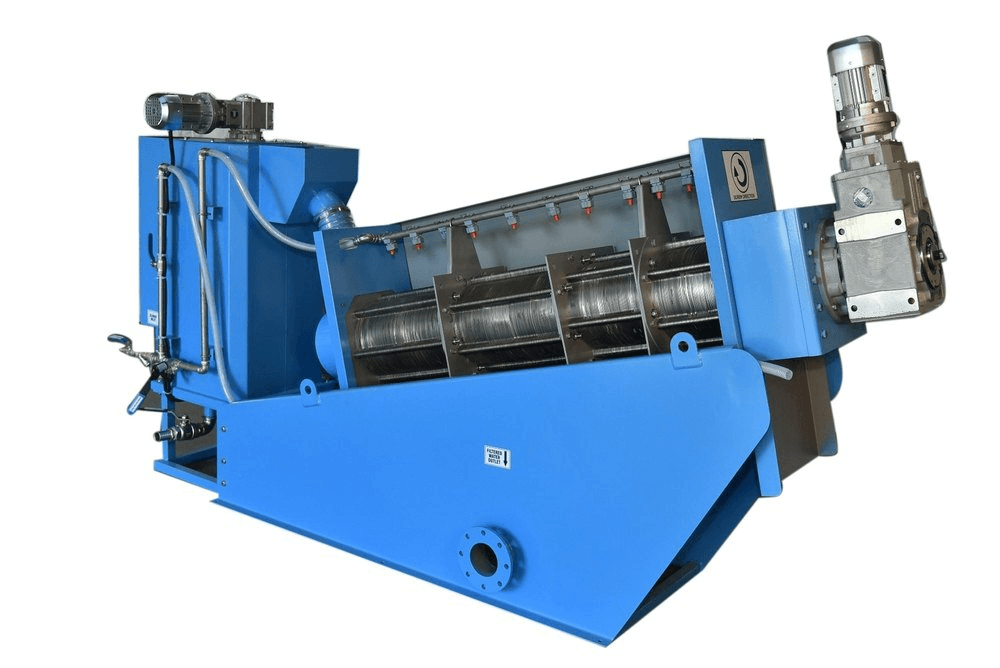
A Filter Press is preferred when high cake dryness, clear filtrate and compact high-pressure dewatering are important. A Screw Press is continuous and lower-speed, often useful where low power and continuous STP sludge handling are priorities. A Bag Centrifuge is compact and batch-operated for smaller sludge volumes. For difficult industrial sludge, a filter press is often the most flexible option because plate type, cloth, feed pressure, cake thickness, chemical conditioning and automation can all be tuned.
Key features
- Available as manual, semi-automatic and fully automatic filter press systems based on operator involvement and discharge cycle requirements
- Recessed chamber, plate-and-frame and membrane plate options for different sludge characteristics, cake dryness targets and washing needs
- Common plate sizes include 470 mm, 630 mm, 800 mm, 1000 mm, 1200 mm and 1500 mm, with larger engineered sizes available for high-volume plants
- Hydraulic closing system maintains sealing pressure during filtration and helps prevent leakage between plates
- Polypropylene filter plates, chemically compatible filter cloths and MS/SS wetted-area options can be selected for industrial effluent chemistry
- Optional plate shifter, drip tray, cake chute, cloth washing, air blow, core blow and PLC automation packages
- Suitable for ETP sludge, STP sludge, WTP backwash sludge, chemical process slurry and metal finishing sludge
- Compact high-pressure dewatering footprint compared with many low-pressure mechanical sludge handling systems
Key outcomes
- Reduces sludge volume and transport cost by producing a stackable dewatered cake
- Improves filtrate recovery so water can be returned to the treatment process where suitable
- Supports cleaner statutory sludge handling by separating liquid effluent from concentrated solids
- Allows plant-specific sizing based on sludge quantity, solids loading, cycle time, cake thickness and disposal target
- Helps industrial plants meet ETP/STP operating requirements with lower manual handling when automation is selected
- Membrane plate options can improve cake dryness where lower residual moisture is critical
Standards & certifications
Designed and fabricated to project specifications with MS/SS structure, PP filter plates and compatible filter cloths. Electricals, hydraulic power pack, guards, instruments and automation can be supplied to applicable Indian project, BIS/IS, factory safety and CPCB/SPCB sludge-handling requirements as specified in the client tender or consent conditions.
Who it's for
ETP, STP, WTP and process plant operators, EPC contractors, OEM package suppliers and maintenance teams that need reliable batch sludge dewatering for chemical, pharmaceutical, textile, food, dairy, metal, power, refinery, municipal and commercial wastewater plants.
Related products
Looking for something specific?
Tell us what you need to spec.
Share your capacity, compliance milestone, and timeline. An engineer responds within one business day.