
Demineralization Plant - DM Plant
DM plants for low conductivity water generation using cation, anion, degasser and mixed bed polishing systems where required.
Request a quote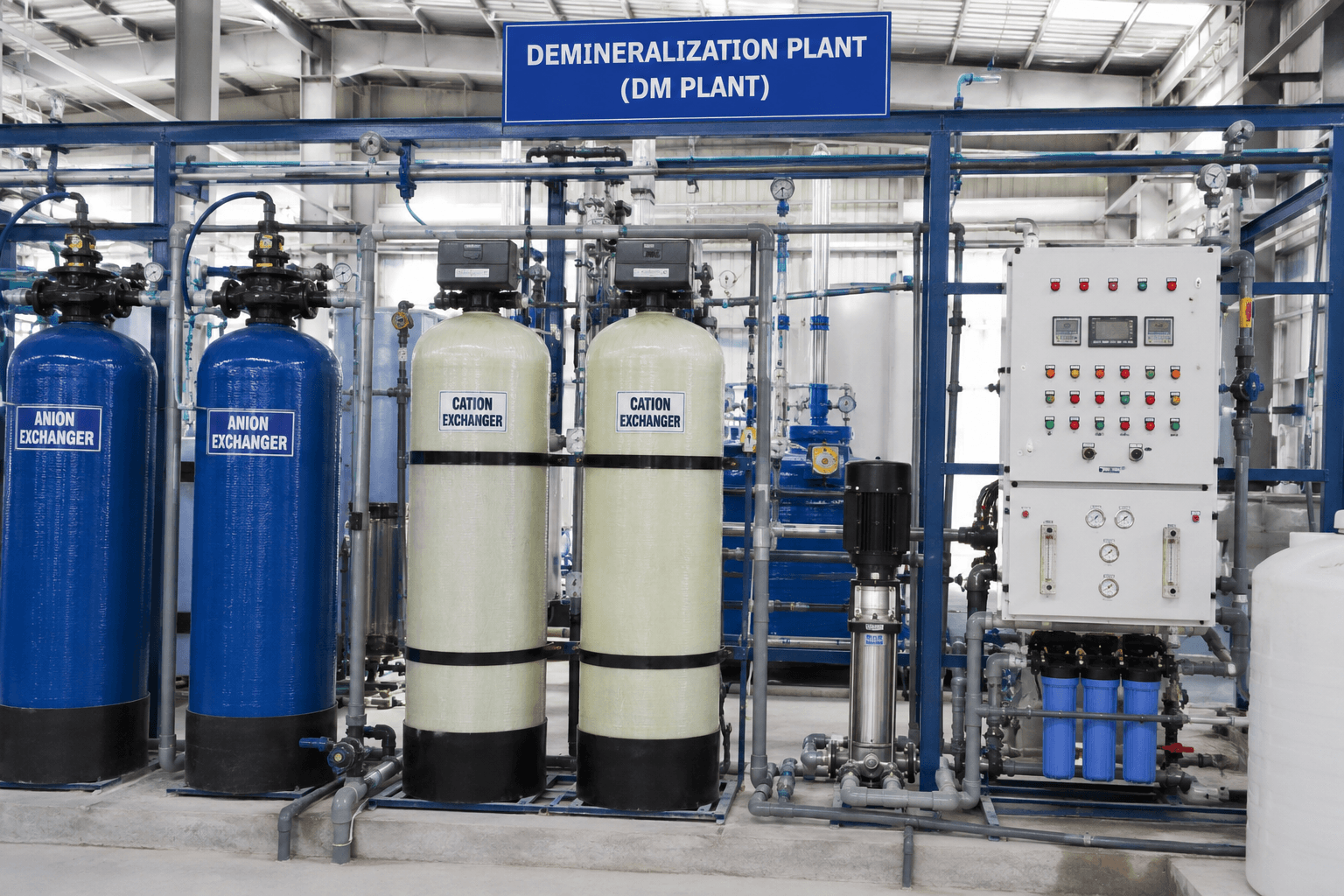
Overview
What is a Demineralization Plant?
A Demineralization Plant, commonly called a DM plant, is an ion exchange water treatment system used to remove dissolved mineral ions from water and produce low conductivity treated water. A typical DM plant may include a cation exchanger, anion exchanger, degasser and mixed bed polisher where required. Terraquaer Venture Pvt. Ltd. designs and supplies DM plants for boiler feed water, process water, pharmaceutical, chemical, textile, power, laboratory and industrial utility systems across Ahmedabad, Gujarat and pan-India projects.
Why is a DM Plant Required?
A DM plant is required when normal filtered or softened water cannot meet the conductivity, silica or dissolved solids requirements of a process. Boilers, turbines, pharmaceutical processes, chemical manufacturing, laboratories and high-quality utility systems may require low conductivity water to reduce scaling, deposition, corrosion risk, product contamination and process variation. DM plants help remove cations, anions and silica depending on the selected configuration and resin design.
When is a DM Plant Selected?
A DM plant is selected when the treated water quality target requires lower conductivity than a softener or conventional filtration system can provide. It is selected for boiler feed water, process water, high purity rinsing, pharmaceutical and chemical production, textile processing, power plant utilities, laboratories and industrial systems where dissolved ion control is important. It may be used after filtration, softening or RO, depending on raw water quality and final water specification.
Where is a DM Plant Used?
DM plants are used in boiler houses, power plants, pharmaceutical plants, chemical industries, textile units, food and beverage plants, dairy plants, laboratories, hospitals, research facilities, process industries, manufacturing units and industrial utility systems. They are commonly installed after pretreatment such as pressure sand filtration, activated carbon filtration, softening or RO, and before treated water storage, boiler feed systems or process distribution.
How Does a DM Plant Work?
A DM plant works through ion exchange. In the cation exchanger, positively charged ions such as calcium, magnesium, sodium and iron are exchanged with hydrogen ions from cation resin. In the anion exchanger, negatively charged ions such as chlorides, sulphates, nitrates, bicarbonates and silica species are exchanged with hydroxide ions from anion resin. Hydrogen and hydroxide combine to form water, reducing conductivity. A degasser may be used after the cation exchanger to remove carbon dioxide and reduce anion load. A mixed bed polisher may be added after the two-bed DM plant where very low conductivity and improved polishing are required.
Technical Overview and Design Factors
DM plant design depends on raw water TDS, conductivity, hardness, alkalinity, silica, pH, free CO2, iron, manganese, turbidity, organic load, flow rate, operating hours, treated water conductivity target, silica limit, resin exchange capacity, regeneration frequency, acid and alkali concentration, rinse water availability, wastewater neutralization need, instrumentation, automation level and operator safety. Terraquaer does not assume final design values without reviewing actual water analysis and process water requirements.
Cation, Anion, Degasser and Mixed Bed Polishing
The cation exchanger removes cations using strong acid cation resin. The anion exchanger removes anions and helps control silica using anion resin, commonly strong base anion resin where silica reduction is required. A degasser removes carbon dioxide after cation exchange, reducing load on the anion exchanger and improving chemical efficiency. Mixed bed polishing combines cation and anion resin in one vessel to polish the water after primary DM or RO treatment, producing lower conductivity water where required by the application.
Regeneration Chemicals and Safety
DM resin requires regeneration after exhaustion. Cation resin is commonly regenerated using acid such as hydrochloric acid or sulphuric acid based on design and site preference. Anion resin is regenerated using caustic soda. Mixed bed units require separate acid and alkali regeneration steps with careful resin separation and mixing procedures. Chemical storage, dilution, dosing, drains, neutralization, ventilation, PPE, eye wash provisions and operator training are important safety considerations in DM plant operation.
Major Components and Scope Elements
A complete DM plant may include pretreated water feed system, cation exchanger, degasser tower, degassed water tank, degasser blower, anion exchanger, mixed bed polisher, resin, pressure vessels, distributors, collectors, acid dosing or regeneration system, caustic dosing or regeneration system, measuring tanks, ejectors, regeneration piping, rinse lines, conductivity meters, silica monitoring where required, pH instruments, flow meters, valves, control panel, safety shower or eyewash provision, neutralization arrangement and treated water storage.
Applications in Boiler, Process and Utility Water
DM plants are used for boiler feed water, high-pressure boiler pretreatment, process water, pharmaceutical production, chemical manufacturing, textile processing, power plants, laboratories, rinsing applications, industrial utility systems and low conductivity water generation. In many modern systems, RO may reduce bulk dissolved solids first, while a mixed bed polisher or DM unit provides final conductivity and silica polishing depending on the treated water requirement.
Operation and Maintenance Requirements
DM plant operation requires monitoring of inlet quality, outlet conductivity, silica where applicable, flow, pressure drop, resin exhaustion, regeneration chemical strength, rinse quality, pH, regenerant consumption and treated water storage quality. Maintenance includes resin health checks, resin replacement planning, valve servicing, regeneration system inspection, conductivity meter calibration, chemical handling review, degasser blower maintenance, leak checks and neutralization system checks.
Terraquaer’s Engineering and EPC / EPCC Scope
Terraquaer supports DM plant projects through water analysis review, process selection, cation-anion-degasser-mixed bed configuration, resin selection, vessel sizing, regeneration system design, instrumentation selection, automation, chemical handling planning, neutralization review, equipment procurement, supply, installation, commissioning, operator training, safety guidance, troubleshooting, resin replacement planning and O&M support. Terraquaer’s approach focuses on treated water quality, safe regeneration, maintainability and lifecycle reliability.
Terraquaer Legacy and Capability Statement
Terraquaer Venture Pvt. Ltd. supports clients with practical, reliable and maintainable water and wastewater treatment solutions. Terraquaer’s strength lies in understanding actual site conditions, wastewater characteristics, client objectives, compliance requirements, lifecycle cost and long-term operation challenges before recommending a treatment system. As an EPC / EPCC environmental engineering company, Terraquaer helps clients from concept development to commissioning and long-term operation support.
Buyer Decision Guide
Before selecting a DM plant, buyers should review raw water analysis, conductivity target, silica target, flow rate, operating hours, pretreatment condition, resin selection, regeneration chemical availability, chemical handling safety, wastewater neutralization, automation need, operator capability, available space and O&M support. Terraquaer helps clients compare DM, RO plus mixed bed, softener plus DM and other treatment routes based on actual process requirements.
Final Call to Action
Contact Terraquaer Venture Pvt. Ltd. for DM plant process selection, resin selection, cation-anion-degasser-mixed bed design, regeneration system design, instrumentation, installation, commissioning, safety review, troubleshooting and O&M support for boiler feed water, process water, pharmaceutical, chemical, textile, power, laboratory and industrial utility applications in Ahmedabad, Gujarat and across India.
Key features
- Generates low conductivity water using cation exchanger, anion exchanger, degasser and mixed bed polishing where required
- Reduces dissolved ions through ion exchange for boiler feed, process water, laboratory and industrial utility applications
- Supports conductivity reduction, silica control and treated water quality improvement based on process requirement
- Uses cation resin, anion resin, regenerant chemicals, acid/alkali dosing systems and instrumentation for controlled operation
- Can be configured as two-bed DM, two-bed with degasser, mixed bed polisher or RO plus MB polishing arrangement
- Terraquaer supports process selection, resin selection, regeneration design, instrumentation, installation, commissioning, safety and O&M
Key outcomes
- Low conductivity treated water for boiler feed, process, laboratory and industrial utility use
- Reduced dissolved salts, hardness, alkalinity and silica depending on selected DM configuration
- Improved process reliability through correct resin selection, regeneration and quality monitoring
- Better operator safety through planned acid/alkali handling, regeneration piping and instrumentation
- Single EPC / EPCC support from design and supply to commissioning, O&M and troubleshooting
Standards & certifications
Final DM plant design depends on raw water TDS, alkalinity, hardness, silica, conductivity, pH, CO2 load, organic load, iron, manganese, treated water conductivity target, silica target, flow rate, regeneration chemical system, resin selection, safety requirements and client-specific process standards.
Who it's for
Pharmaceutical, chemical, textile, power, food and beverage, dairy, laboratory, process industry, boiler utility, institutional and manufacturing clients requiring low conductivity water for process, boiler feed, washing, formulation, utilities or industrial applications.
Looking for something specific?
Tell us what you need to spec.
Share your capacity, compliance milestone, and timeline. An engineer responds within one business day.